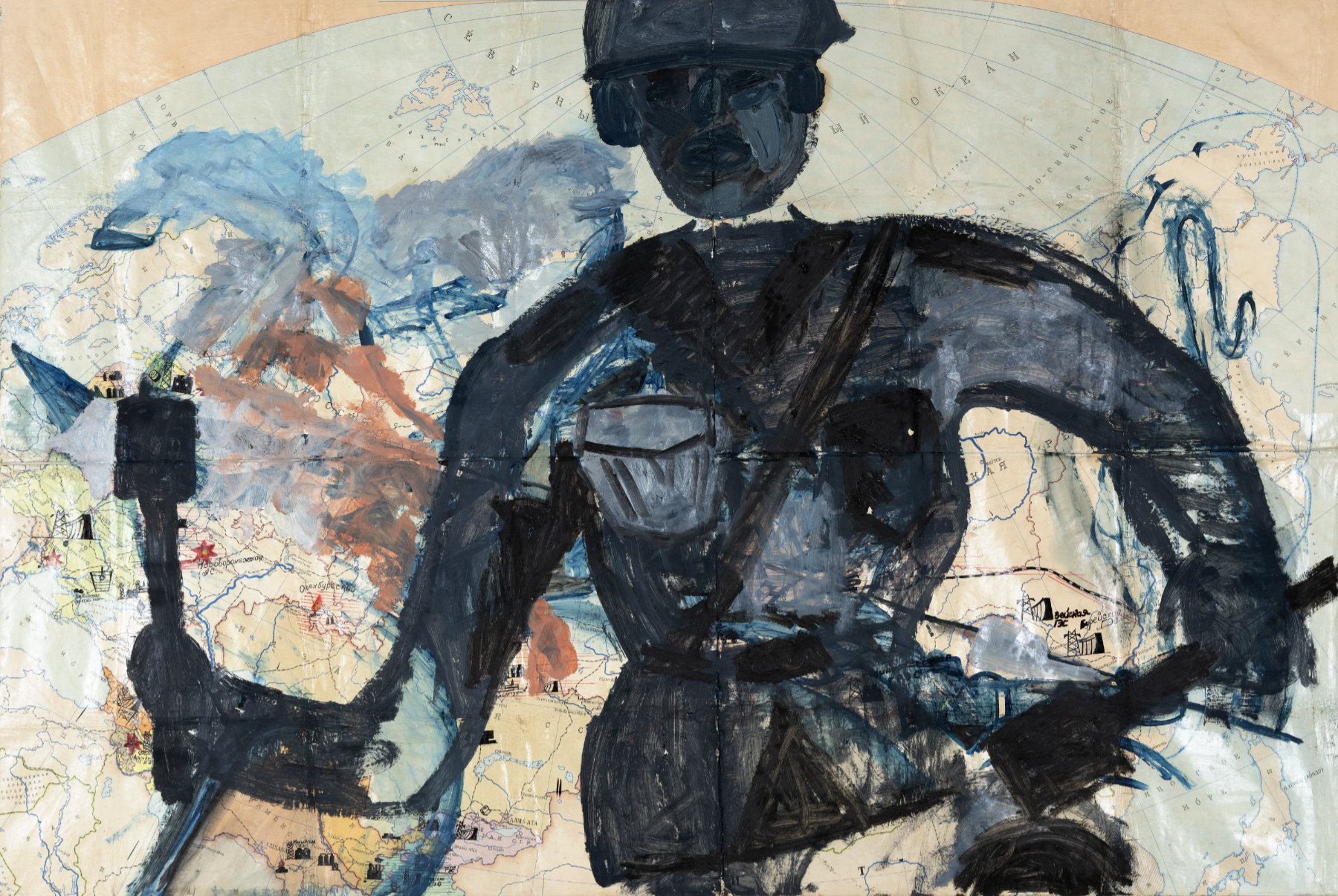

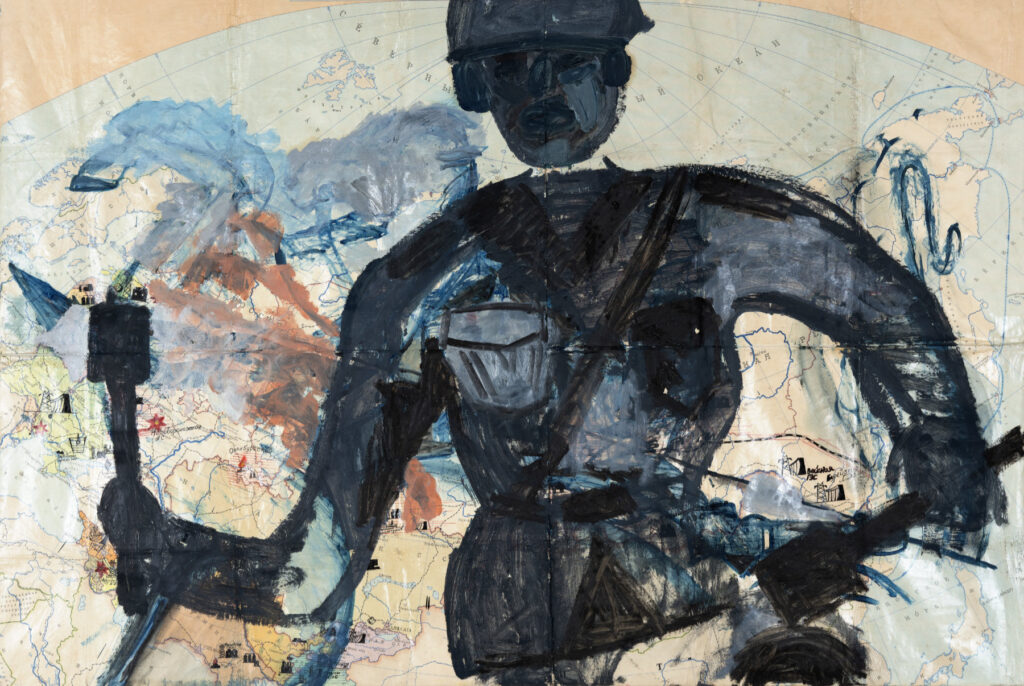
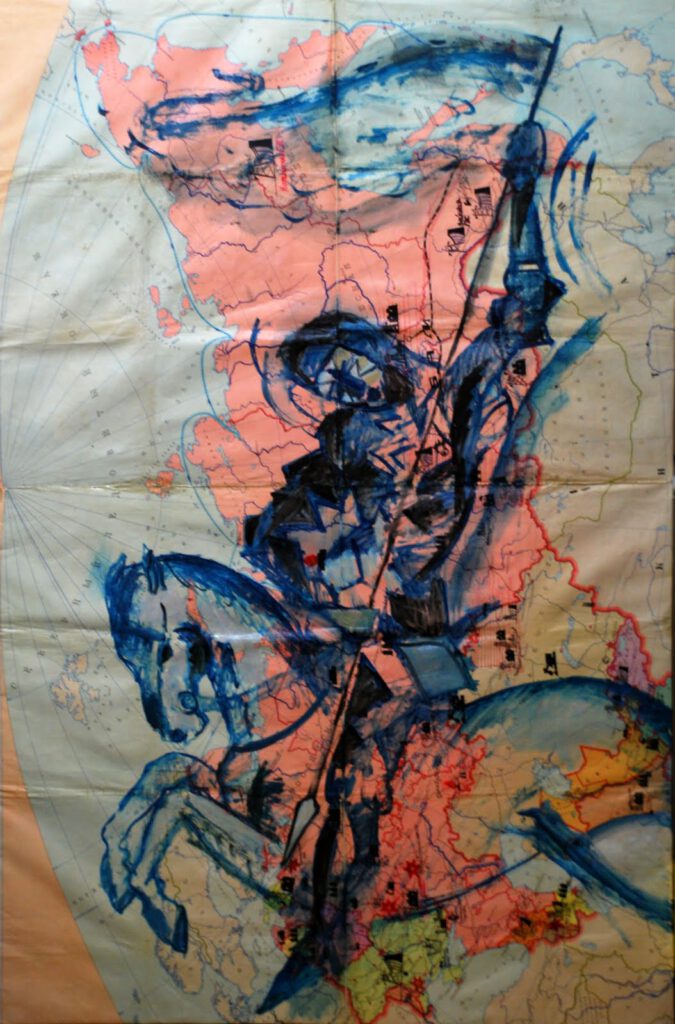
Oil on Soviet school map, 1961 · 2011–12 · Heiner Buhr
I buy old maps at the Dry Bridge flea market in Tbilisi. Usually 20 to 30 Lari for a large one. I have 70 or 80 of them by now — Soviet military maps, school maps, economic maps, maps of places that no longer exist under those names. On about 25 of them I have painted.
This map painting was the first.
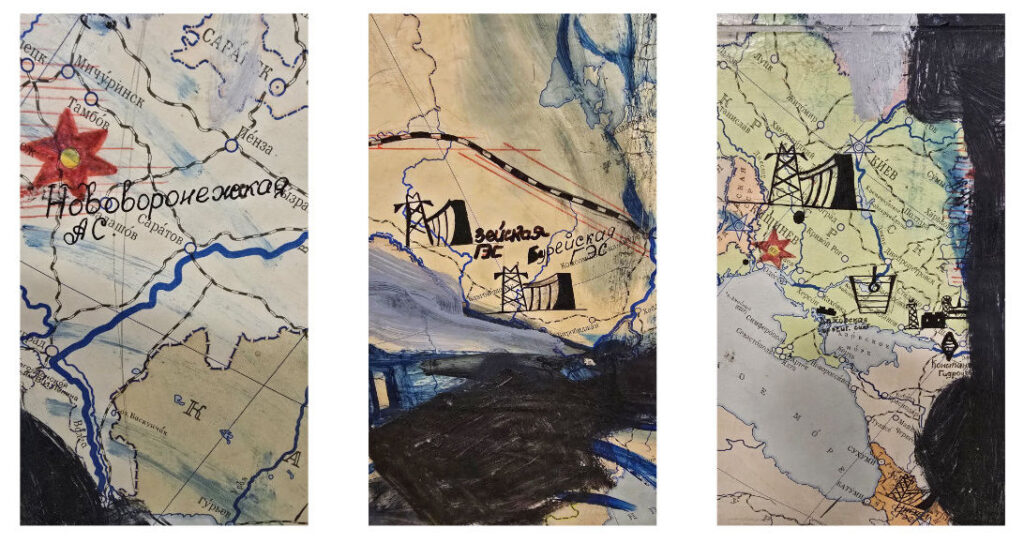
It’s a Soviet school map of the USSR, 1961. It came from a Tbilisi school — you can see the wear of it, the fold lines, the way it was handled by many hands over many years. A geography teacher had added his own layer: power stations, marked in black ink, drawn by hand directly onto the map. Cooling towers, electricity pylons, oil derricks. Novovoronezhskaya nuclear plant. Zeiskaya hydroelectric station. Bureyskaya GES on the Amur. The infrastructure of empire, annotated in a classroom somewhere in the 1960s.
I stretched it onto a canvas frame and hung it on my studio wall.
Saint George on the Soviet map felt Kitsch
The first thing I painted on it was Saint George killing the dragon.
Tsereteli’s golden monument to Saint George stands on a column in the center of Freedom Square in Tbilisi — Georgia defeating the dragon, the symbolism obvious after August 2008. It felt like the right image for a Soviet map. Resistance. Victory of the small over the large.
I painted it in portrait format. A horse, a lance, the dragon beneath.
It didn’t work. It was kitsch. Too obvious, too easy, too close to propaganda — just pointing in a different direction. I painted over it.
Around that time I had been reading Zbigniew Brzezinski. The Grand Chessboard, 1997.
His thesis: whoever controls the Eurasian landmass controls the world. After 9/11, after the Russo-Georgian War of August 2008 — which I watched from here, in Tbilisi, while guiding German tourists — the argument had a different weight than it carried in 1997. The chessboard was not a metaphor. It was this map on my wall.
One evening I painted the soldier. One hour. Brutal strokes of black. No face, no side, no name. A figure in a dark quilted combat suit — the mushik of the Shtrafbat, the Soviet penal battalion soldier in his black vatnik. He emerged from the map in about an hour and I knew immediately: this is right. This is what the picture needed to be.
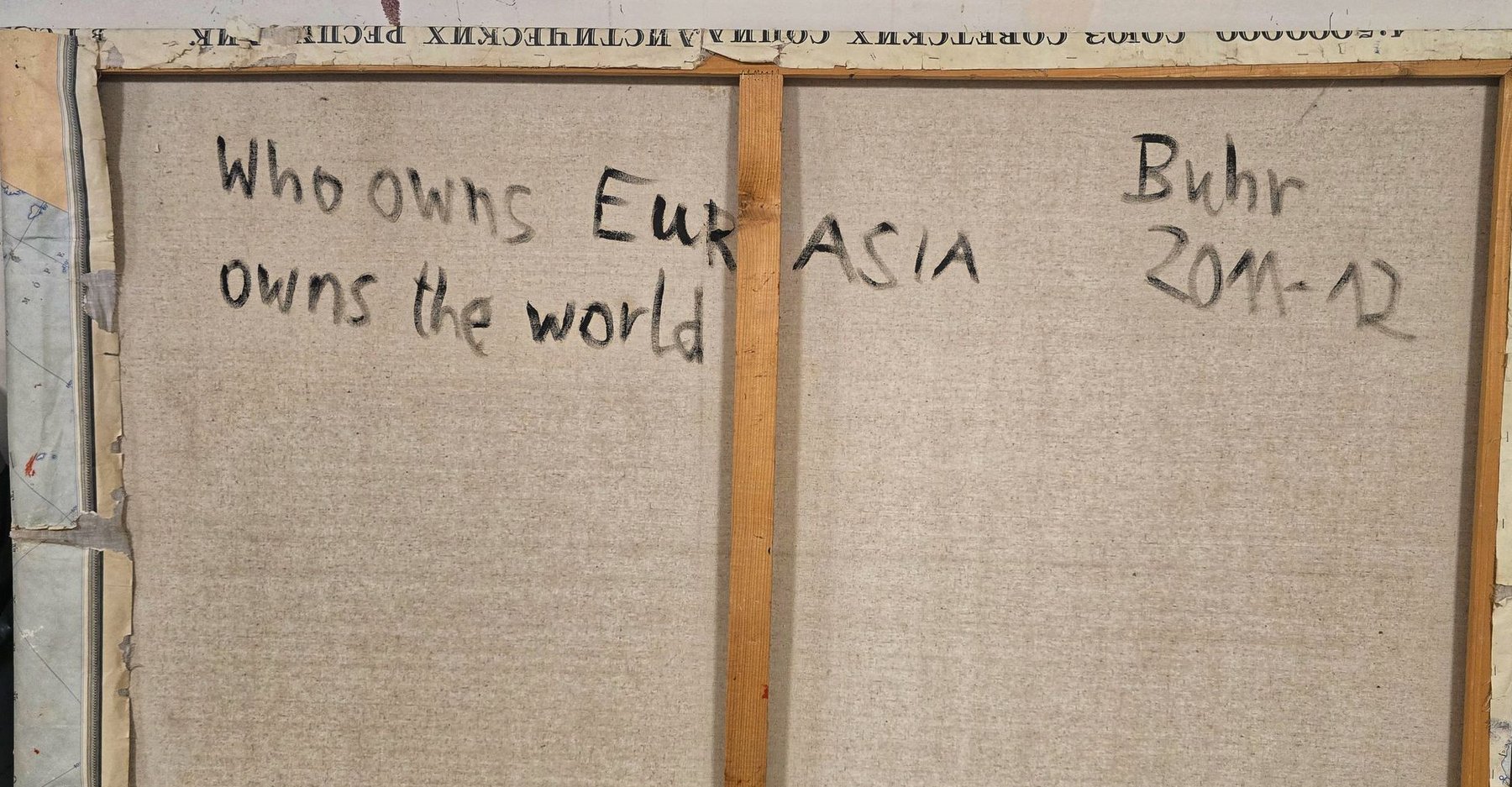
I wrote on the back: Who owns Eurasia owns the world. Buhr, 2011–12.
Im Bewährungsbattalion
The Soviet penal battalions — Shtrafbaty — were the backbone of the Red Army’s most dangerous operations. Criminals, deserters, political unreliables. They went first. They absorbed what the front had to give. Cannon fodder with a chance at redemption through blood.
There were equivalent units on the German side. They were called Bewährungsbataillone — the 500er battalions. For deserters, for the politically unreliable, for men guilty of Wehrkraftzersetzung — undermining military morale. Political jokes. The wrong remark to the wrong person.
My great-uncle Hans Schnick was sent to one in 1943.
Six days apart, December 1944. Two poems typed on the same machine.
Wie der surrende Pfeil in das Tier, ihr zur Beute,
Wie der raffende Wurf des säend Schreitenden
Wie die wärmende Klarheit unerschöpflicher Sonne
ist die Liebe —
Wie das Atmen des Meeres in unendlichem Morgen,
Wie die stille Wölbung allnächtlicher Mondbahn,
Wie das lautlos fallende Sterben im herbstlichen Nebel
ist die Sehnsucht —
Wie die eisengeschiente Faust in den Nacken der Bestie —
Wie der unverrückbare Stamm wetterschützender Bäume —
Wie der Mantel des Knappen über der Wiege des Kindes
ist die Treue —
22.12.1944 — Hans Schnick
Like the humming arrow into the animal, its prey,
Like the sweeping throw of the one who strides and sows,
Like the warming clarity of inexhaustible sun
is love —
Like the breathing of the sea in endless morning,
Like the silent arc of the nightly path of the moon,
Like the soundless falling death in the autumn fog
is longing —
Like the iron-shod fist at the neck of the beast —
Like the immovable trunk of weather-sheltering trees —
Like the squire’s cloak over the cradle of the child
is loyalty —
22.12.1944 — Hans Schnick
Nun fällt der erste Schnee —
Aus all der Drohung über stummen Wipfeln
Ist dieses Schweben uns geworden
Und hüllt in seinen Schleier ein
Die Toten auf den Feldern.
Legt sich, ein letztes Siegel, noch
In ihren Mund.
Herr,
lasse mich vergehn in tränenlose Schwere
Vergib mein Irren auf den falschen Wegen
Und lehre mich der Demut letzten Grund
28.12.1944 — Hans Schnick
Now falls the first snow —
From all the threat above the silent treetops
This hovering has come to us
And veils in its sheer cloth
The dead upon the fields.
Lays itself, a final seal,
Upon their mouths.
Lord,
let me dissolve into tearless weight —
Forgive my wandering on the wrong roads
And teach me the last ground of humility.
28.12.1944 — Hans Schnick
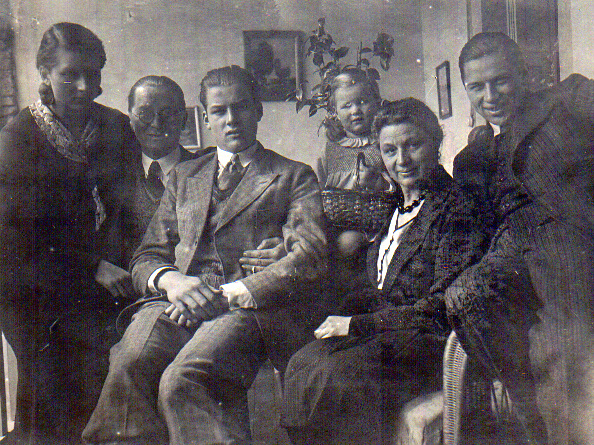
Hans Schnick – War Surgeon and Poet
was a surgeon. Before the war he had been something else entirely — a pianist, a poet, a young man in Paris in the circle of Jean Cocteau. Then the war came and he became a military doctor on the Eastern Front, operating in conditions that no training prepares you for.
Sometime around 1943 he made the mistake of telling political jokes. He was charged with Wehrkraftzersetzung and transferred to a penal battalion. He survived that too — Hans Schnick survived everything the war threw at him.
In 1946 he took his own life on a railway station toilet in Braunschweig. He used morphine, which he had access to as a doctor. I am named after him — Hans. Hans Heiner Buhr.
His brother Karl Schnick — my grandfather — was an Abwehr intelligence operative. He survived the war hiding in Bucharest, was arrested in 1947, sentenced to 20 years as a spy, and bought free by West Germany around 1957.
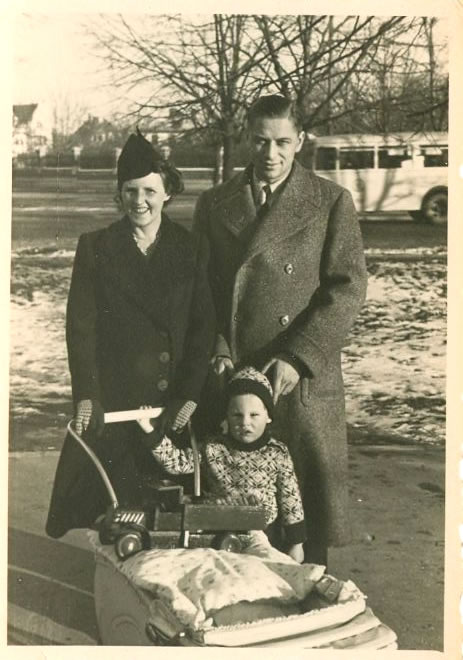
Karl’s wife Ilona (my grandmother) lost both her brothers in the war — one in Greece, one in Russia.
Four people from one family. One comes home broken and dies by his own hand. One spends a decade in prison and is bought back. Two don’t come back at all.
Two German warriors fight against two Georgians
My wife Teona is Georgian. Her grandfathers fought on the Soviet side — Sergo wounded in the North Caucasus, Akvsenti who made it all the way to the Brandenburg Gate in 1945. A few hundred meters from Checkpoint Charlie, where I grew up.
Our children have four great-grandfathers. Two German, two Georgian. They fought on opposite sides of the same war. All four survived.
The black soldier on the Soviet map stands for all of this. Not for one side. Not for victory or defeat. For the mass of it — the machinery, the infrastructure of power that the geography teacher drew in black ink in a Tbilisi classroom in the 1960s, the chessboard that Brzezinski described in 1997, the war that took Hans Schnick to a railway station in Braunschweig in 1946.
I painted him in one hour. Brutal strokes. No face.
So stimmt das Bild. That’s when the painting was right.
“22.Juni 1941” – the German soldier on a Soviet map
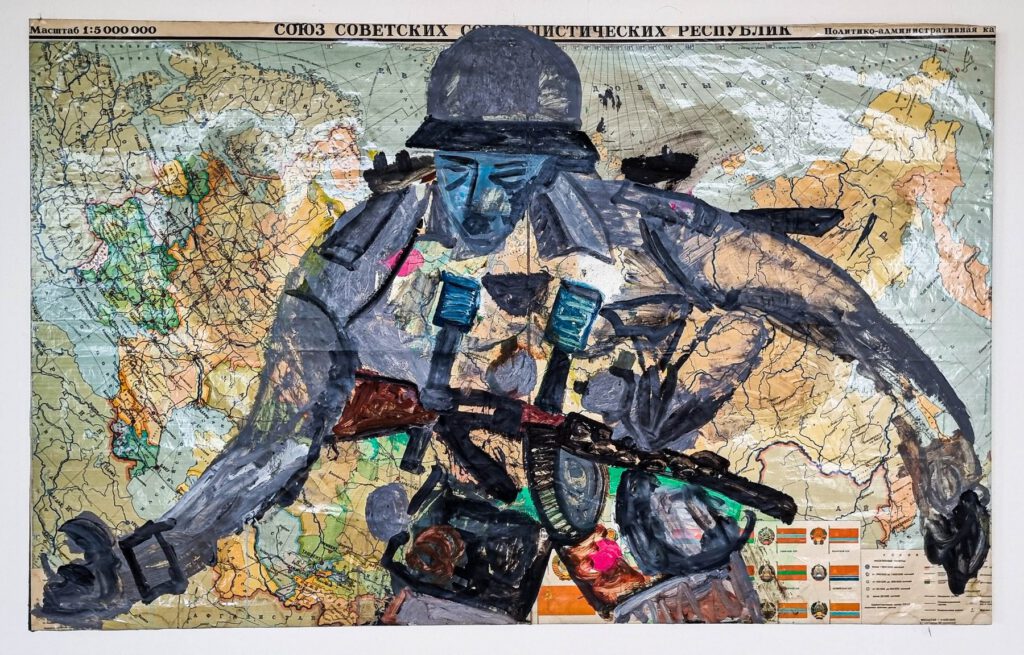
A year later I painted the pendant. A German soldier in full combat gear — helmet, a trophy Kalashnikov, ammunition pouches — advancing across a Soviet political-administrative map of the USSR. The title is the date of the German invasion of the Soviet Union: June 22, 1941.
Together the two works form a diptych. One soldier stands. The other attacks. The same landmass. The same war — seen from both sides.
This is the first painting in an ongoing series of works on Soviet and historical maps, begun in Tbilisi in 2011. The maps are bought at the Dry Bridge flea market in Tbilisi for 20–30 Lari each. The series currently comprises approximately 25 works.
🌐 Also available in: Deutsch · Nederlands · Русский
Newsletter
New paintings. New texts. New places.
Directly to your inbox.