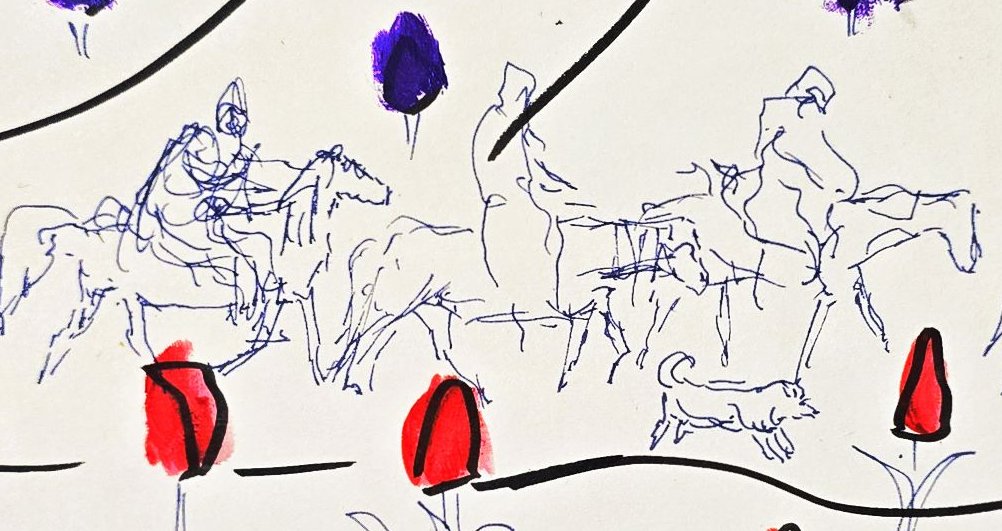

These three drawings are part of my ongoing return to the motif of the caravan: horses, riders, pack animals, mountain lines, flowers, dust, and the open routes across the Caucasus and beyond.
Three fast Drawings
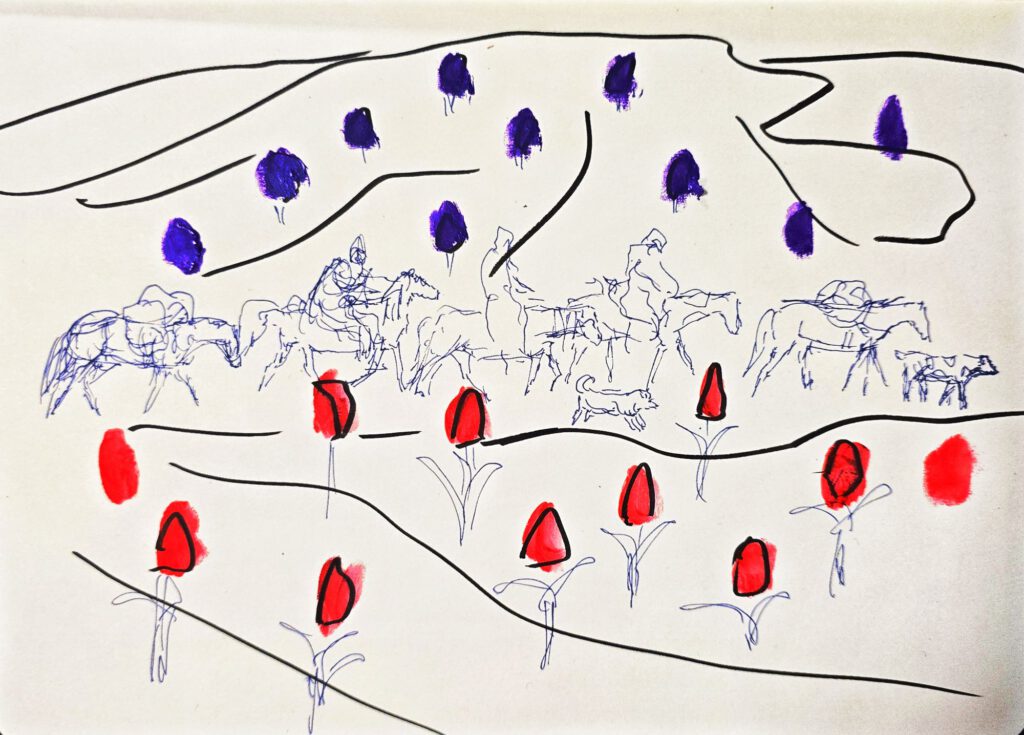
The caravan has appeared again and again in my work. Sometimes it is a historical image, sometimes a memory of travel, sometimes only a line moving through a landscape. For me, it carries many things at once: trade, exile, longing, danger, and the old desire to move further — toward the East, toward the South, toward an unknown source.
The first drawing, with red tulips and dark violet forms, is almost like a map of an inner landscape. The horses and riders move through the middle of the page, while the flowers and hills become signs, fragments, almost like memories.
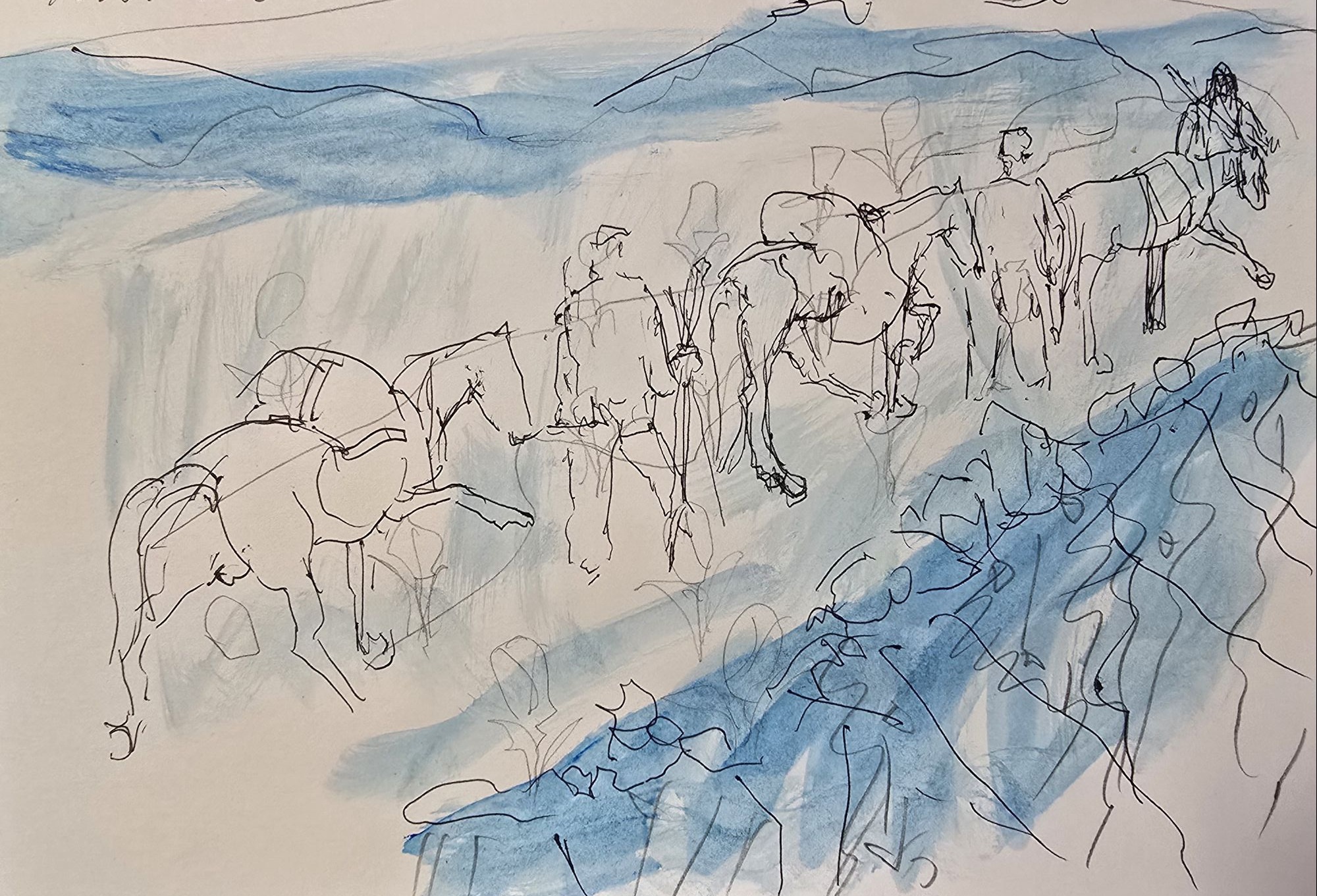
The second drawing is looser and colder, with pale blue mountain shapes. Here the caravan feels more exposed, almost suspended between snow, water, and distance.
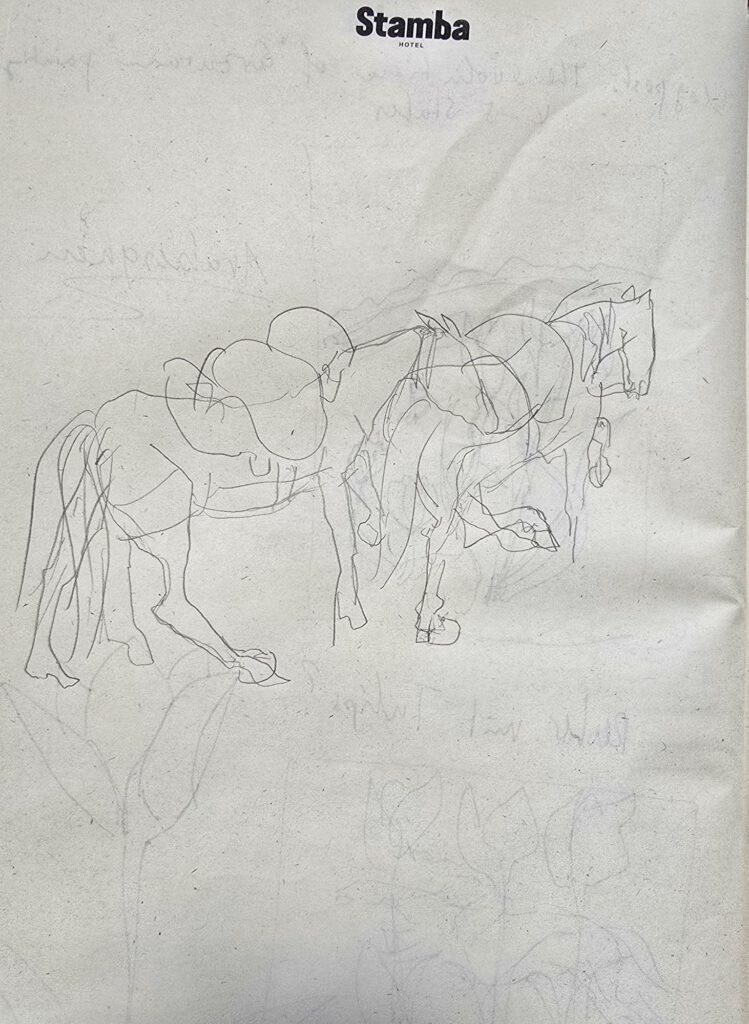
The third drawing, made on Stamba Hotel paper in Tbilisi, is reduced to two pack horses. It is more like a note from a sketchbook — simple, fragile, but close to the source of the motif.
The poem “Desire” came from the same atmosphere: the Caspian shore, salty sand, horses’ nostrils, porcelain, cinnamon, coffee, Isfahan, tulips in a sandstorm. It is not a precise geography, but an inner one.
The Poem
Desire
Along the Caspian shore
salty sands blow into my horses’ nostrils.
The turban cloth drawn over watery eyes,
dry palate, tobacco smoke, arabesques.
Two hundred miles of heavy loads —
porcelain, spices, cinnamon, rubies, coffee —
direction Isfahan.
Along pistachio and mulberry trees,
through patches of old snow,
Turkish tulips sway in the sandstorm.
Crows, a black vulture,
and a mirage.
A tender lover
with sweets and tea in my tent.
Laughing jackals.
Where is the source?
South. South.
Tbilisi, 16.05.2026